Wednesday, September 7, 2011

 
     SHOSHONE VILLAGE BIRDING
I'm Len Warren Staff Naturalist for Shoshone Village, CA.
 I would like to invite you to Shoshone Village for excellent desert birding. Shoshone Village is a small oasis village which is the southern gateway to Death Valley, and sits along the riparian vegetation of the Amargosa River. The Shoshone-Tecopa bird checklist stands at 259 species. We welcome your additions to the checklist. There are 5 major birding areas here. Shoshone Village, Shoshone Wetlands, Tecopa & Tecopa Wetlands, Amargosa Canyon, and of course China Ranch. Comfortable rooms at Shoshone Inn can be your base camp, or Shoshone Campground has nice spots for RV or tent camping.   A key to the  Warm Springs swimming pool is included with your stay in at the inn or campground.(You'll not be disappointed) I'd love to take you on a private birding tour.
Warm Springs Pool
. At the Crowbar Restaurant , FREE weekly bird walks begin every Sunday at 8 AM. The Shoshone birding trails begin at the Crowbar with the Blue Trail. From one blue pole , one can see the next blue pole and so on along a path which may change your idea of desert birding. The blue trail hold several pairs of Crissal Thrasher,  Black-tailed Gnatcatchers, Verdin, and Bewick's Wren. Phainopepla are present from Sept until May. During migration they are joined by many mountain habitat nesting birds on their way back to Mexico, and Central and South America. During winter, Shoshone's Phainopepla's hold individual feeding territories beginning in Oct.In winter they compete with Mockingbirds, Western Bluebirds, and Cedar Waxwings for the sticky, glue-like, berries of the Desert Mistletoe. Juvenile Cooper's Hawks hunt the Shoshone Wetlands all winter. I often find their feeding spots , littered with feathers of their prey, often Gambel's Quail, or Northern Flicker in winter. Long-Eared Owls nested several spots throughout the village in 2010.

SHOSHONE WETLANDS BIRDING  TRAILS
Just follow the poles to discover Shoshone Wetlands Preserve. Please explore, respect, and enjoy this 1000 acre private nature preserve.
Crissal Thrasher, Black-tailed Gnatcatcher, Verdin, Bewick's Wren, Greater Roadrunner,Say's Phoebe,  and Loggerhead Shrike,are year round residents of the trails. Bell's Vireo,Lucy's Warbler, Yellow Breasted Chat, Hooded Oriole, Western Kingbird, Blue Grosbeak,Indigo Bunting, breed here in spring and summer.


During winter, Shoshone's Phainopepla's hold individual feeding territories beginning in Oct.pair up in February, and breed in March and April.In winter they compete with Mockingbirds, Western Bluebirds, and Cedar Waxwings for the sticky, gluelike, berries of the Desert Mistletoe, as they ripen. Juvenile Cooper's Hawks hunt  small birds on the Shoshone Wetlands all winter. I often find their feeding spots , littered with feathers of their prey, often Gambel's Quail, or the red-shafted  Northen Flicker in winter.

During migration? All birding  bets are off and Shoshone, Tecopa, Amargosa Canyon, and China Ranch are all known migrant traps , almost anything can be found here! (see our checklist)


The BLUE TRAIL ,an easy 1/2 hour walk,  Pole #1 begins at the Crowbar restaurant and heads straight out into the Shoshone Wetlands, a private nature preserve bordered by BLM Wilderness. Shoshone Wetlands is dominated by Honey Mesquite and Screwbean Mesquite trees. The Blue trail wanders through the wetlands and along the  Shoshone spring  and the Amargosa river , at pole #16 it splits off on a loop (10-15 extra minutes) that walks through prime desert riparian bird habitat.  .The loop returns to pole 16. The Blue trail returns to Crowbar or connects with the Aqua trail at the confluence of the Amargosa River, and Shoshone Spring.


The RED TRAIL ,
Red Trail- Just follow the poles.
  an easy 1/2 hour walk , begins at the Shoshone Campground, and heads North out to the Amargosa River, loops back to the South,  crosses a spring, and returns to the Campground. or connects to the Aqua-Connector Trail,   The Red tail is habitat to all the same species as the Blue Trail

GPS work along the Aqua Trail for the Amargosa Canyon Songbird Project
The AQUA-Connector trail, connects the Red Trail and Blue Trail , 1/2 hr from Red to Blue, along the path of the Amargosa River, as it has carved its path over time.On the East side are the mud-hills and washes coming off the mountains, and on the West side is the Amargosa River, often flowing above ground, supporting a unique habitat type and excellent birding for desert birds and migrants. This trail reconnects with the Blue Trail at the confluence of the Shoshone Spring, and the Amargosa River, a particularly pretty and interesting spot.

The SWIMMING POOL TRAIL begins behind the pool area and is marked  by Aqua poles soon to be tipped in white. This is a 5 minute walk and has benches to sit in the shade and enjoy a lovely marshy meadow,ans sometimes smalll ponds, both  unusual in the desert, and at times full of birds, as well as butterflies, dragonflies, and other wildlife.

Thursday, September 1, 2011

Yellow Breasted Chats Along the Amargosa River and Shoshone Wetlands

If you come to Shoshone from late April through Mid July, you can easily find Yellow-breasted Chat. They breed here every year, and the males sing beginning as early as 4 am.
Display flight/ male  Yellow-Breasted Chat
 Yellow-breasted Chat is one of the most vocal of all the songbirds along the Amargosa River, They arrive here in late April, and claim territories in the shadiest,darkest, and most challenging vegetation, usually very close to water.The males show off with a marvelous singing display flight to proclaim their territory. The song repertoire of a chat is extensive. Males sing from various high perches within the territory, along the river,and it's tributary springs as many as 8 at a time can be heard singing and counter-singing in the north end of the Amargosa Canyon. Females are extremely quiet, and secretive.They make certain  sounds near the nest . Females do not sing, but make short , single note calls that can help us discover the nest location. To find the nest of a Chat, one must be still, wait within the territory to hear the female "near calls" then quietly track the female. I have found a few Chat nests in my work, this year 4, but most of them still manage to elude me. I often search for hours and give up, walking away,while the males sing and display in a way that feels to me like they're laughing at my incompetence, and congratulating themselves on their  successful territorial defense and secrecy.  I feel fortunate that although  many although birders have had very few precious looks at a Chat, I'm able to get great looks at them every day during breeding season.

There are still a few Chats along the Amargosa River, but most have raised their young and have departed  in July,for Mexico, and Central America, as far south as Panama. I already miss them, and I'm looking forward to April again.


Wednesday, August 31, 2011

Long Eared Owl babies in Shoshone Village, CA

My apologies to all who asked about, and anyone who is interested, for being absent from this blog through the breeding season. It has been a very busy season ,now winding gradually into fall migration.

First of all I would like to thank the volunteers who helped me on my project this year, thank you Richard, Carol, Darlene, Molly, Susan,Christiana, Dorothy, Mr Ko Meung (Mike), Jon, and  Per. I appreciate you all ,and your interest, your time, and especially your friendship.I will remember. Thank you McCreedy for hiring me out here as a nest searcher in the first place. Thank you to my whole family for helping to get me out here at all.

Here are some superstars from Shoshone Breeding season 2011.


Monday, April 11, 2011


These fun Anna's Hummingbird photos were easily taken by setting the garden hose on "mist" and then putting it in the tree above some hummingbird feeders. I'm sure it would work well for any species, but it works great in the desert! Anna's and Costa's Hummingbirds are constant daily customers and at sunset there can be as many as 15  on and around around the feeders.Normally, hummers fight all the time, but just before sunset, a truce seems  to occur, and they all settle together, each taking a space at the feeders.

  Last night, a pair of Hooded Orioles which has been around, came down from the Athel trees and arrived at the feeders, and stayed for awhile. They are very cautious, and descend to the feeders step by step, and seem to try to stay hidden as much as possible. I will try to get a nice picture of them.


There are so many birding delights to see around Shoshone, but I really want to show these cool Chuckwalla photos. He was in the rocks above the trail below China Ranch.
Long-eared Owls are  now nesting in Shoshone, there are at least 2 nests in town.They wintered all around Shoshone, Tecopa, and Ash Meadows. Long-eared Owls are nomadic in winter and often roost communally until pair courtship. There were at least 7 pairs around Shoshone, and could usually be heard every night around sunset. The courtship flights by the males included much wing -clapping. Wing clapping is the noise made by the wings slapping  together on the down-stroke, while  the male flies around the proposed nest area in a bobbing and weaving pattern,.
On March 19th, the Red Rock Audubon Society had a field trip to Shoshone, and found  a pair perched about 20 feet up in a local Athel tree grove. The next morning, the female was down deep in the crotch of the tree and has not left since. Females do not leave the eggs during daylight hours, therefore the Saturday observation was probably with no eggs, and Sunday was probably the first egg. Females can lay eggs over 2 weeks , so I waited until April 9th, and climbed up to check.


We soon will have baby owls in Shoshone!  The complete clutch is 4. The first should hatch on or around April14 th.The rest can hatch over the next 10 days depending on when they were laid.
Sine then I have found one more Long-eared Owl  nest in town and it has 2 eggs already.


Tuesday, February 8, 2011

Death Valley Spring Morning


I was amazed at how many wildflowers are blooming already in Death Valley. 


Nest Tree of a Loggerhead Shrike


Bones in front of a Burrowing Owl burrow

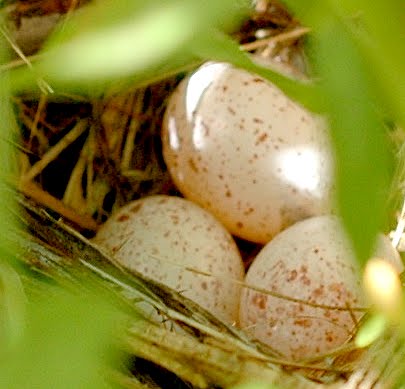
Shrike Eggs


Spring is here right?


Thursday, January 27, 2011


photo by Len Warren
                           Need Crissal Thrasher?.......Shoshone, CA 92384

Crissal Thrasher- (Toxostoma crissale)- A common resident of Shoshone,(10-20 pairs) very secretive, more easily heard than seen. Crissal Thashers thrive in the mixed riparian, vegetation along the Amargosa River, dominated by Honey Mesquite and Screwbean Mesquite. The Crissal Thrasher rarely flies, preferring to walk or run around its territory and will mostly run for cover when disturbed by a potential predator *wi. In late January, the male begins to sing. A member of the mimidae , a natural mimic, the male mimics the songs and calls of local and migratory birds. The nest is usually very well hidden, in deeper, darker, denser vegetation. Crissal Thrasher is very difficult to observe. Breeding season Jan-June  provides the most reliable looks at this species. Listen and look for the male singing from various high perches throughout their territories. Approach slowly, do not follow too closely, listen carefully, and you will be rewarded by a close look at a pair of Crissal Thrashers on their breeding territory. Please  respect their hard earned space by minimizing playback, and learning their behavior, songs and calls.

Tuesday, January 11, 2011

Verdins are fascinating


photo by Colin Wooley
Verdins in Shoshone are fascinating.They are year round residents in mesquite dominated desert riparian areas.. They build wonderful fascinating dome shaped nests of thorny twigs, lined with a thick layer of feathers.The nest building is done by both the male and female.If you are lucky enough to find a Verdin nest under construction, the real work of art is revealed . A lacy dome or globe is formed by expertly propping, weaving, and maneuvering the thorny twigs into place.As the sphere forms,the adults collect spider webs by actually grabbing the web, and wrapping it around the beak by moving beak in little circles and figure eights.The webs are then taken to the nest and used  for bonding material. The presence of fresh spider webs and greenery  is a clue used to determine which nest is the active nest .During nest building , the often male arrives first, looks all around, gives a single note call, maybe the all clear. The female then arrives with a big twig, huge for a 3-4 inch bird, or a beak full of feathers. Although the nests are easy to find, Verdins are sometimes  very careful about showing their active nest location. They sound alarm calls when you enter their territory,  and sometimes won't go anywhere near the nest if you are close. They can  have very large territories for such little birds.They can build a nest and lay  an egg in as little as 4 days! A typical  Verdin territory in Shoshone can have as many as 10 inactive nests and one active nest within their territory..They often build a nest and do not use it. Some literature states that the male builds several nests and the female chooses one. I have not found this to be the case at all. Although they often abandon nest building attempts, they seem to build together  or abandon together .Occasionally a pair begin a nest, completely stop building, nest nearby, then finish the original nest and use it for a second brood.Verdins also have been known to build their next nest while  still incubating at the first nest. Another interesting nest building method is to stack a second nest right on top of a previous one, or right below it for that matter.Once,in Arizona,  I have seen a pair actually building 2 nests  simultaneously, intertwined so that the top of one made the bottom of the other, they made two entrance holes, but then only finished, lined, and laid eggs in one of the nests. In winter, they seem to loosely hold territories. They build  roost nests which are often smaller and sometimes not lined. Some winter roosts are well lined.The lining used for breeding season is the softest downiest cushion that you would ever imagine. When you carefully reach into a Verdin nest to check it's contents and are lucky enough to find a B-100,this means 100% finished and lined and ready for eggs, you'll be amazed at how plush the lining is. The lining material is a precious commodity in the desert.
  Verdins have several vocalizations. The song vs. the call can sometimes be difficult to determine.The male "song" can be a one, two, or three syllable whistling " tseet" or "tseet- tsoor" or "tseet- tsoor -tsoor", the female's response call is a quieter version of the single note "tseet". There are gentle, quiet, warbling,musical, twittering calls used by the pair when they greet one another near the nest.  Both sexes use the scolding call a repeated, staccato chip, chip, chip or tip, tip, tip, and the predator call..The predator call is difficult to describe but it is a repeated, je-je-je-je-je, a machine-like sound that reminds me of a cactus wren song, but higher pitched.During winter, I have heard only the scolding call, until yesterday, when I began to hear verdins using the tseet single note call all over Shoshone. Male Verdins will soon become aggressive toward each other, than pair formation will begin. Nesting usually Peaks in late April,  but continues in Shoshone till July.
in 2010 there were 20 pairs of Verdins on the Shoshone nesting research plot. PRBO (Point Reyes Bird Observatory) has conducted a long term research project here since 2005 that monitors all speciesof songbirds nesting along the Amargosa River.