
Wednesday, November 4, 2015
Painted Bunting in Shoshone VIllage


Shoshone Days Birdwalk
 |
 |
| Vermillion Flycatcher photo by Martin Powell |
 |
| White-throated Sparrow photo by Martin Powell |
This White-throated Sparrow,rare in the west, was in with a bunch of common White-crowned Sparrows eating fallen dates below the date palms. Yellow-rumped Warblers were doing the same and Elena Esparza was able to get this awesome shot, as well as the great shot of the group. Thank you Elena for all your help and photos.
Martin Powell spotted and photographed this sneaky little Brown Creeper,
 next to the Shoshone Pond, normally a dark woods tree trunk bird, they are occasionally found along the Amargosa in the winter. Martin also spotted and photographed this Marsh Wren, another winter visitor that is extremely difficult to get a good look at!
 |
| Brown Creeper photos by Martin Powell |

 |
| Marsh Wren photo by Martin Powell |
A great aerial battle by Common Ravens, and a flyover by an Osprey were also highlights.
NEXT FREE BIRD WALK IS SUNDAY NOV 8TH AT 8AM -CROWBAR CAFE
Sunday, October 25, 2015
Raptors of Shoshone Tecopa and the Amargosa River
Just about every type of Vulture,Hawk, Eagle, and Falcon appear in our area at some time .
Here are a few of my favorites.
Northern Harrier (juvenile plumage)

Northern
Harriers breed regularly in Shoshone, and Tecopa Marsh. On the first night that
I arrived here from Maine in 2009, I
witnessed the “mid-air food toss” at sunset of the male Northern Harrier
dropping a fresh prey item in flight to the female who swooped up, grabbed it
easily and disappeared back down into the nest area. I have been hooked on
Harries ever since. They are present year round in Tecopa Marsh but the birds
are not necessarily the same individuals year round. On Tecopa Marsh, Harriers often easily move
Coyotes away from the nest area by landing near the Coyote, allowing it to
approach, then moving to an enticing nearby spot, and repeating the process
until the Coyote is out of the Harrier territory. Northern Harrier is a “California Species of
Special Concern” due to marsh-like habitat destruction throughout California.
 |
| Adult female Northern Harrier In the spring, as early as February, the sky-dance of the male Northern Harrier begins. He can be heard over Shoshone Wetlands or Tecopa Marsh, calling rapidly while making rapid ascents and descents . Usually he is displaying to the female, but I have observed a male sky-dancing another male apparently as a territorial display, laying claim to the prime Harrier habitat, not to mention the female therein. Males are known to have more than one female, sometimes several, correlating to his ability to provide. Reverse sexual dimorphism is very apparent when the pair is seen together. The female looks almost twice as big as the male. |

Their plumages are completely different. Northern Harriers
are easy to identify with a little practice, and can be found in marshes from
Alaska to Central America.
There are 13 Species of Harriers in the world. Our Northern Harrier is extremely closely
related to the Hen Harrier which occupies similar habitat types throughout the Northeastern
Hemisphere, from Portugal to Japan.
American Kestrel

At 7.5”-8” this is the 2nd smallest of all the worlds’ 39
Falcon species, all in the genus Falco. Only the Seychelles Kestrel is smaller.American
Kestrel has a huge range. It covers most of the Western Hemisphere from Alaska
to Tierra del Fuego.. They are beautiful, graceful, and take a variety of prey
from grasshoppers, dragonflies, to lizards, and small birds.
Locally, Kestrels are often seen in winter hunting from power poles and wires
around Shoshone, and a pair is often found around Tecopa Marsh, and or the
Amargosa Canyon during breeding. Kestrels will use a nest box of the following dimensions.
Prairie Falcon

Prairie
Falcons are our year round resident falcon. They do breed in this area, I have
found their nests more than once. They breed up on high cliffs. Prairie Falcons
average only slightly smaller than Peregrine Falcons. Reverse sexual dimorphism
is apparent in the size differences between males and females. According to “Falcons
of the World” by Tom J. Cade, males weigh as low as 17.5 ounces and at the most
22.5 ounces, females as much as 34.5 ounces. Imagine a 17.5 ounce male and a 34.5 ounce
female! When seen as a pair they seem almost a different species. Prairie
Falcons can take a great variety of prey items from large insects and small
birds to Chuckwallas Desert Iguanas, Desert Cottontails, Black-tailed
Jackrabbits, and any type of rodents.
 |
| See the powerful legs of Prairie Falcon |
 |
| Prairie Falcon putting on the brakes Peregrine Falcon 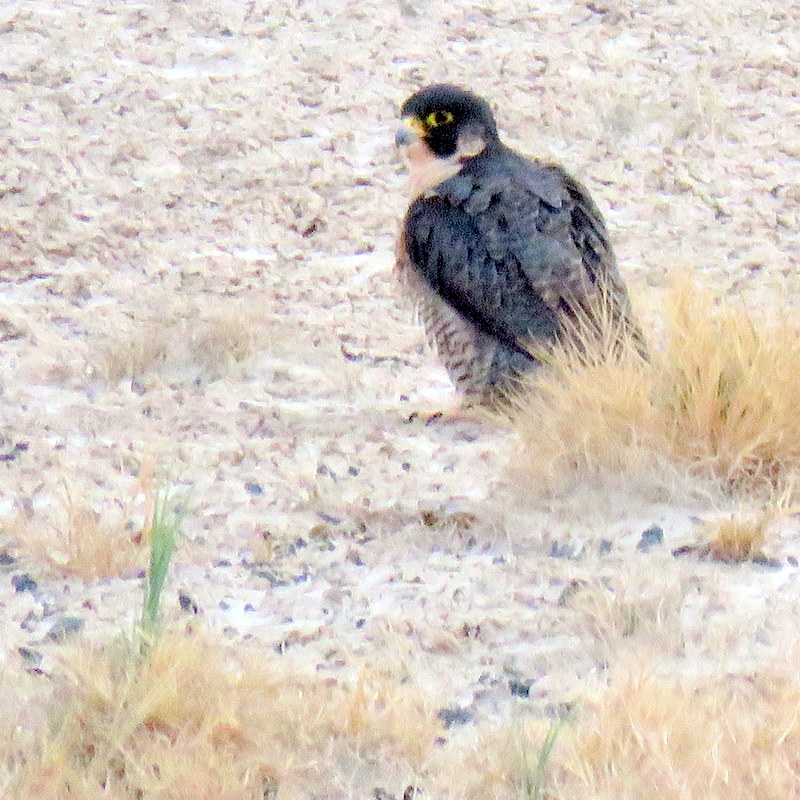
Peregrines are occasionally seen in Shoshone and Tecopa in
the non-breeding seasons. Over the last few years, a pair has been seen during
June, which indicates possible breeding somewhere in this area. The closest
known breeding pair is Mt Charleston in nearby Spring Mountains.
Peregrines,
are mainly bird catching machines. They use many different hunting strategies.

Peregrines the fastest known birds, when diving, called the stoop, from amazing
heights at even more amazing speeds! Although average prey sizes are not quite
so dramatic, even the 6 foot wing-spanned Great Blue Heron is not safe from a
Peregrine. Imagine a 47 inch tall Great Blue Heron a formidable predator, being
hit by the talons of a 53 ounce Peregrine Falcon from behind in the neck at 275
miles per hour!
Peregrines reverse sexual dimorphism is exaggerated with
males weighing in from 24.5 to 30 ounces and females up to 53 ounces.
Weight References: Falcons
of the World ,by Thomas Cade
Red-tailed Hawk
Red-tailed Hawks are also year round resident species. Locally they are known to breed on the high walls of the Amargosa Canyon, and occasionally in rare, tall isolated trees or groves of trees. The Amargosa Canyon sometimes has two pairs of Red-tails nesting in the cliff faces. Dark plumage varieties of Red-tails as well as typical “western” plumage forms are found in the Amargosa Canyon.
Chocolate plumage Red-tailed Hawk
Red-tailed Hawks take a variety of snakes, big lizards,
rodents, rabbits, road kill, and road injured animals and birds of any type.
Many Red-tailed Hawks are injured or killed in collisions with vehicles.
In 2012 as Staff Naturalist for Shoshone Village, I helped
kids at Death Valley Academy in Shoshone, make wildlife videos as a joint project
with Partners for Fish and Wildlife. Check this one out” Red-tailed Hawk eating
Coot brains, a Death Valley Delicacy” by one of the kids in 10th
grade at the time.
Red-shouldered Hawk

Red-shouldered Hawk
Juvenile
Red-Shouldered Hawks often winter in Shoshone. They do breed locally as close
by as Pahrump, NV. 27 miles away. It is not known whether the Red-shouldered
hawks that often arrive in Shoshone are dispersing from Pahrump or whether they
are from far away.

This Juvenile Red-shoulderd Hawk has been hanging around the new Shoshone bird pond for a few weeks.
More raptors soon!
|
Thursday, October 8, 2015
The rain came.

It was beautiful
to see waterfalls cascading down the normally dry rock mountains while driving
through Chicago Valley.PHOTO

Great birding has followed the rain.

As the land warms and dries, insects are hatching
everywhere. The birds have been lining
up along the new Pupfish Creek Trail

 |
| The only time I've ever seen a Verdin flycatching!(repeatedly catching insects in mid-air and then returning to the starting perch to feed) |
There
are Coyote Willows, Goodings Willows, Honey Mesquite, and Screwbean Mesquite.
The bulrushes, and other creekside plants give insect eating birds and
excellent habitat to eat, drink, bathe, and preen.

Come and see Shoshones' Pupfish Creek for yourself!
Len Warren
Staff Naturalist
Shoshone Village, CA 92384
Thursday, October 1, 2015

Yellow-rumped Warblers are the most common species of
warbler in North America. Locally, they breed at higher elevations such as the
nearby Spring Mountains. In September, they arrive in Shoshone and all along
the Amargosa River and will be present for the entire winter.

It is not known
whether the same individuals are present all winter or if there is a “flow” of
them constantly going through. Most likely some combination of the two. There
are two species of Yellow-rumped Warbler in North America.


My opinion is that there are rare and unusual birds going through Shoshone and
the entire Amargosa River Valley all the time, but go undetected due to lack of
observers.
RARITES
I recent years,
rarities around here have included Wood Thrush,


. In nearby Pahrump, NV, a Hooded Warbler wintered at the Cantino’s place a couple years ago. Warbler watching is really challenging.Your best bet is to try to get a look directly at the face of the bird. Like sparrows, Warbler faces are usually definitive.
Monday, September 28, 2015
I’m writing this blog as Staff Naturalist for Shoshone
Village, California 92384. Shoshone is a very small town.

WOODPECKERS OF THE AMARGOSA
CLICK HERE TO SEE MY VIDEO OF LADDER BACKED WOODPECKER
 |
| LADDER-BACKED WOODPECKER RANGE MAP Source:(http://sdakotabirds.com/species/ladder_backed_woodpecker_info.htm) |
 |
Nuttal's Woodpecker Owens River NORTHERN FLICKER |

Northern Flickers seem to arrive first in the fall, and their “keer” call
can be heard throughout the day. They will be present all winter into early spring.
Often seen on the ground, and a major predator of ants, they’re known as
Red-shafted Flickers for the display of red feathers from the underside when
the wings opened. They must be more commonly preyed upon by hawks during the
winter than other birds, because each spring, in my travels I’ll find the orange-red feathers in
shady places. I’ve found many almost full sets of red flight feathers in such “kill
spots”.
The
Northern Flicker has a huge range in North America. From Newfoundland to Alaska, in the north and from
Cuba to the Pacific Coast and as for south as CostasRica, , Flickers
are common and prolific.
In the east they are Yellow-shafted Flickers. In the midwest
the flight and tail feathers begin to be more orange, then more red in the west.
They are all of the same species. Occasionally, a Northern Flicker
yellow-shafted is reported in this area. I was really jealous last winter when, while
working at Shoshone’s Crowbar Restaurant, my friend Terri showed me in a
plastic bag, a set of yellows that she had found! Finally in spring of 2015, I finally found a set of yellows!!


 Notice how
the shafts of the feathers have been clipped by the beak of a hawk. Also here
you can see the special shape of the “designed for strength” tail feather. (Black
tipped)
Notice how
the shafts of the feathers have been clipped by the beak of a hawk. Also here
you can see the special shape of the “designed for strength” tail feather. (Black
tipped)
Red-naped Sapsuckers and
Red-breasted Sapsuckers are both found around Shoshone in fall and winter. The trees around Shoshone Village, Shoshone Campground, the Death Valley Academy, and Shoshone Birding Trails and China Ranch, are all good spots for wintering woodpeckers.
 |
| RED_NAPED SAPSUCKER |
 |
| RED_BREASTED SAPSUCKER |
LEWIS'S WOODPECKER

It’s always special to see a Lewis’s Woodpecker. A
pink-breasted iridescent black-bodied woodpecker whose behavior and flight
patterns seem different than the others.

The only woodpecker
known to do “flycatching” , a mid air
grab of an insect , then returning to the original perch, they are also the
only woodpecker known to perch on a wire! They are occasionally found in surprising
numbers. Although I have only ever seen individual Lewis’s Woodpeckers, I have
heard a credible first hand report of 35-40 of them in one tree during
migration in Furnace Creek in nearby Death Valley National Park.
 |
| LEWIS'S WOOODPECKER |
I recently
got these great shots of Lewis’s Woodpecker at nearby (90 miles is nearby for
around here!) Spicer Ranch in Beatty, NV.

Thanks to Dave Spicer for showing me the great birds there.
More on Woodpeckers later.
References: Atlas
of the Breeding Birds of Nevada 2007 University of Nevada Press , Reno
Frances Backhouse, Woodpeckers of North America,Firefly
Publishing, 2005
Monday, September 21, 2015
 Flycatchers in Shoshone and along the Amargosa River.
SAY’S PHOEBE video click here
There are an amazing amount of Flycatcher species that use Shoshone and the Amargosa River. Some are migratory and breed elsewhere. Some are migratory and breed here. Say’s Phoebe (pronounced feebee) is our only year round Flycatcher.
Say’s Phoebe is a classic Phoebe in that it is the one who makes a nest up in the eaves of an old building or garage. Their subtle coloration is like an American Robin yet washed out. If one watches Say’s Phoebe for a while, spectacular courtships flights and flycatching aerobatics will be the reward. Their nest sites in towns and villages throughout the Desert Southwest are well known, but their nest sites in the wild are often spectacular. Caves in high, hard to reach cliffs, almost any protected nook with a small shelf.

I’m often surprised by a Say’s Phoebe that I’ve accidentally flushed from such a place after a challenging trek.

 More Amargosa Flycatchers coming soon.
Subscribe to:
Posts (Atom)